
Indian Institute of Technology Madras (IIT Madras) said on Monday that it had raised the highest-ever corpus of annual funds for the institution, garnering Rs 231 crore from alumni, industry and individual donors for 2022-23 (FY23). Its funding increased 76 per cent year-on-year (YoY) compared to Rs 131 crore in FY22, according to data shared by the institute. The number of donors contributing more than Rs 1 crore increased 64 per cent YoY.

He also said that infrastructure development in the country in the last eight years has been done with a human touch.


The data-generation ability of technology can not only provide real-time feedback on its return on investment but also evaluate education programmes.

According to various global media reports, China is creating Covid-like pathogens in Pakistan that have the potential of causing virus contamination on a scale far higher than Covid.
In August, the central bank had announced that it will set up the Reserve Bank Innovation Hub (RBIH) to promote innovation across the financial sector by leveraging on technology and creating an environment that would facilitate and foster innovation.

From the Sensex pack, Larsen & Toubro jumped 4.26 per cent to emerge as the biggest gainer, followed by IndusInd Bank, Tech Mahindra, State Bank of India, HCL Technologies, Power Grid, NTPC, Axis Bank, Kotak Mahindra Bank, HDFC Bank and Wipro. Mahindra & Mahindra, Infosys, UltraTech Cement and Hindustan Unilever were the major laggards.
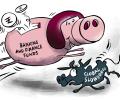
Even as banks and finance companies are reporting record-high earnings, their weighting in the benchmark National Stock Exchange Nifty50 Index has seen a downward trajectory. Investors expect a stronger performance from other sectors in the new year. Currently, banking, financial services and insurance (BFSI) companies collectively hold a weighting of 34.5 per cent, down from 36.7 per cent at the end of December 2022 and a record high of 40.6 per cent at the end of December 2019. This represents the sector's lowest weighting in the index since December 2021 when it stood at 33.7 per cent.

As the world celebrated International Day of Persons with Disabilities (PwD) on December 3, corporate India has kept up with efforts to make workplaces more inclusive and accessible. Organisations across sectors are taking initiatives such as equipping offices with practical work tools like Braille-friendly and voice-enabled lifts and screen readers. While inclusion has gained pace, only 11.3 per cent (or 3.4 million out of 30 million) Indians with disabilities have jobs.

More than 70 per cent of Indian youth aged between 15 and 29 can't!

The PMO said mass yoga demonstrations will be organised at 75 iconic locations across the country under the leadership of 75 Union ministers, with Modi attending the exercise at Mysore.

While the Indian Institute of Technology (IIT) Kanpur may have attracted among the highest donations by an individual (former student and IndiGo Airlines co-founder Rakesh Gangwal) at Rs 100 crore last week, IITs have largely seen such contributions rise over recent years, despite the Covid pandemic. According to Mahesh Panchagnula, dean, Alumni and Corporate Relations, IIT Madras, in the last five years, the premier institute has raised more than Rs 135 crore under the endowment category of education alone. Despite the pandemic, there has been an increasing trend in endowment funding received at IIT Madras, with an average increase of about 20 per cent year-on-year across the last five years.

States have been told to prepare in advance to counter any impact of an adverse southwest monsoon.

By 2030 India will be among top three countries in science and technology: PM

'If we go in the same direction as them, we cannot expect a different result from them.' 'Our fall is going to be very swift.' 'Within a decade, we can expect the situation to change for the worse.'

Over 5 million alumni from the Indian Institutes of Technology, Mumbai University and Institute of Chemical Technology, Mumbai, plan to raise Rs 21,000 crore to start the world's largest infection testing lab in Mumbai.

The recent report in the New York Times that China had brought India's financial capital - Mumbai - to a halt by hacking the electricity supply grid has not come as a surprise to the CTOs (chief technology officers) and cyber security experts. Indian companies, including critical infrastructure providers such as power grids, ports and radar systems, lack the IT infrastructure to prevent hacking from hostile state actors like China and North Korea, warn security experts. Recently, the United States government warned of yet another breach of critical systems tied to Microsoft Exchange email systems that the company has blamed on China. The breach has impacted thousands of organisations in the US and its impact on India is still unknown.

Two senior government functionaries said the task has been given to the North Eastern Space Application Centre (NESAC), a joint initiative of the Department of Space (DoS) and the North Eastern Council (NEC).

The paper suggests the strategy needs to be area-specific eg, border tourism can be promoted aggressively in the Turtuk or Siachen sector, and Daulat Beg Oldi or Depsang plains.

Tech giant Microsoft will set up its largest and fourth data centre in India at Hyderabad with an investment outlay of over Rs 15,000 crore over a period of 15 years. "I am very happy to say today that Hyderabad will be the destination for Microsoft's largest Data Centre investment in India with an investment of over Rs 15,000 crore over a period of 15 years. "This will be one of the largest FDIs that Telangana has attracted," Telangana Minister for IT and Industries KT Rama Rao on Monday said at an event marking the announcement of Microsoft's latest data centre region in Hyderabad.

The management was open to attracting qualified people from the US for either short-term or long-term assignments in Roorkee, reports Manu Shah.

Even as Chinese troops continue squatting on territory that we claim as our own -- this was the lowest allocation for defence in percentage terms since the 1950s, reveals Ajai Shukla.

Nomura Group Study found that in 2019, out of the fifty-six companies which shifted their production out of China, only three of these invested in India; while 26 went to Vietnam, 11 to Taiwan, and 08 to Thailand. In April 2020, Nikkei noted that out of the 1,000 firms which were planning to leave China and invest in Asian countries, only 300 of them were seriously thinking of investing in India.

The jury is still out on whether this will lead to re-skilling.

Why did the Chinese military take over the lab in Wuhan in end January? Did something go wrong? Claude Arpi glances at the mystery surrounding the origin of the coronavirus.

'With nearly double the market share of our nearest competitor, we are shaping the digital transformation journey of close to 1,000 clients in India.'

Hercules Singh Munda's father used to open the gates to a forest. Today, Hercules leaves for London to open the gates of his many dreams.

IT services market in the country grew at a slower pace of 7.4 per cent to Rs 22,826.2 crore ($ 3.76 billion) in the January-June 2014 period, mainly due to political and economic uncertainty amid Lok Sabha polls, research firm IDC said.

Appointing Neemuchwala is seen as a big shift for Wipro.

'To set up a successful business, one must have a solution to an existing problem or a better way of addressing the current solution.'

With his elevation as the CEO of Twitter, Parag Agrawal, in whom co-founder of the microblogging giant Jack Dorsey has "bone-deep" trust, joins the growing power club of Indian-origin executives helming US-based global multinationals. Twitter's outgoing CEO Dorsey announced on Monday that 37-year old Agrawal, an Indian Institute of Technology, Bombay and Stanford University alumnus, will be the company's new chief executive as he stepped down after 16 years at the company that he co-founded and helmed. A report in The New York Times said Agrawal will receive an annual salary of $1 million, in addition to bonuses, restricted stock units and performance-based stock units.

'The minimum holding period for equities should be three years.' 'Try goal-based investing.' 'Link your equity portfolios to specific goals such as retirement, purchase of a house or car...'

'I have realised that if we want to make a difference in global ranking, there has to be movement in a few dimensions, but it is a bit beyond us.' Outgoing IIM-A director Ashish Nanda discusses his tenure at the revered institute with Vinay Umarji.

Illustrious international thinkers met at the Milken Institute Global Conference 2021 and many discussions addressed the impact of the COVID-19 pandemic on the world at large.

With the advent of new banks, IT firms will get boostto their businesses.

The latest circular from BSE that sought to cap the price movement of select scrips, especially the mid-, small-cap segments, traded on the exchange is not without a reason. A quick calendar year-to-date price check on the stocks from the categories put under 'Add-on Price Band Framework' by the BSE reveals a total of 210 stocks have seen their market price more than double. Among individual stocks, SC Agrotech, Adinath Textiles, Waaree Renewable Technologies, Steel Strips Infrastructure, Unistar Multimedia, Texel Industries, Raja Bahadur International and Hindustan Everest Tools from the BSE's X and XT group have rallied over 500 per cent during this period. Topping the charts is Gita Renewable Energy, which has zoomed 3,964 per cent to Rs 272.35 now from Rs 6.7 as on December 31, 2020.

Among the 36 new faces in Prime Minister Narendra Modi's council of ministers, eight are lawyers, four are doctors, two former IAS officers and four MBA degree holders, besides several engineers, making it an eclectic mix of professionals.

While there is a shortage of testing kits, manpower and capacities, India does not have other scalable testing options.

But the measures, particularly in agriculture, may not be enough to revive the sector and double the farm income, says S Mahendra Dev.

Cities are setting the rules that now carry life and death implications for their residents, and most of these rules are sought to be set by the municipal authorities who have never wielded such power, reports Subhomoy Bhattacharjee.
 © 2026 Rediff.com - Advertise with us - Disclaimer - Privacy Policy - Sitemap - Feedback - About us - Terms of use - Grievances